
1. Private AI Infrastructure: The Secure Future of Business AI in 2026
Artificial Intelligence (AI) is transforming how modern businesses operate. Companies use AI for content creation, customer support, data analysis, coding, research, and everyday workflow automation. As AI adoption grows, concerns about data privacy, cybersecurity, compliance, and intellectual property protection are also increasing — which is why many businesses are now turning to Private AI solutions
For example, employees may enter sensitive company information into public AI tools. This information could include customer records, financial reports, source code, contracts, internal documents, and strategic business plans. Once sensitive information leaves the organization’s controlled environment, businesses may have less visibility into where it is stored and how it is handled.
As a result, many businesses are increasingly considering Private AI Infrastructure to use AI capabilities while maintaining greater control over their valuable business data.
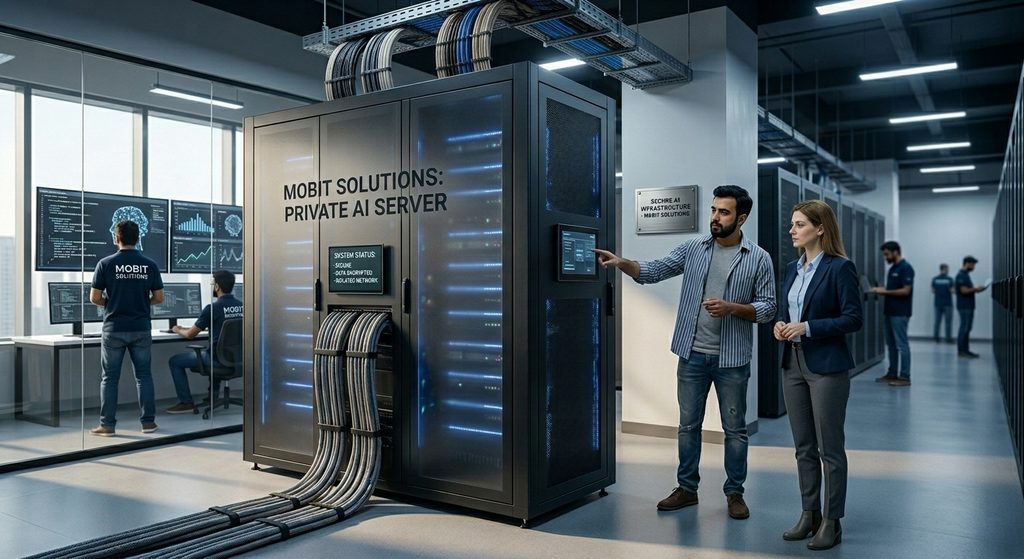
2. What Is a Private AI Server?
A Private AI Server is an AI environment dedicated to a specific organization. It can be deployed on the company’s own premises or hosted in a secure private cloud. Unlike public AI platforms, this setup gives businesses greater control over their data, security, and AI workflows.
- Complete ownership of business data
- No external data sharing
- Enhanced cybersecurity controls
- Regulatory compliance support
- Full customization and scalability
With these capabilities, organizations can use modern AI tools while keeping important business information within a controlled environment. This allows employees to benefit from AI capabilities while businesses maintain greater control over their data and internal systems.
3. Why Businesses Are Paying More Attention to Private AI
Organizations today generate and process enormous amounts of data.
According to industry reports:
- More than 90% of the world’s data has been created within the last few years.
- Cybercrime damages are projected to exceed trillions of dollars annually worldwide.
- Data breaches can cost organizations millions in recovery expenses, legal fees, and reputational damage.
- AI adoption in enterprises continues to grow, with organizations increasingly integrating AI into their daily operations.
As a result, businesses must balance AI innovation with strong security practices. At the same time, cyber threats and data breaches continue to create financial and operational risks.
AI adoption makes this challenge even more important. When employees use public AI tools for work, businesses need to understand what information is being shared and whether appropriate controls are in place.
Without a clear AI strategy, confidential information could potentially be exposed outside the organization’s controlled environment. Therefore, businesses need an approach that supports AI adoption without compromising data security.
Private AI Infrastructure offers such an alternative. It allows companies to use AI for business operations while maintaining greater control over their data and internal systems.
4. The Risks of Using Public AI Tools for Business Data
Public AI platforms can be useful for many business tasks. However, businesses should understand the potential risks before allowing employees to use them with sensitive information.
1. Sensitive Information May Leave the Organization
Employees may copy and paste confidential information into AI tools to make their work easier.
For example, this information could include:
- Customer databases
- Financial statements
- Source code repositories
- Employee records
- Legal documents
- Intellectual property
Without clear policies and controls, companies may not have complete visibility into how this information is processed. As a result, sensitive business information could potentially leave the organization’s controlled environment.
2. Compliance Can Become More Difficult
Many industries operate under strict data protection and security requirements. Depending on the organization and location, businesses may need to consider standards and regulations such as:
- GDPR
- HIPAA
- PCI DSS
- ISO 27001
- Financial and industry-specific regulations
Using AI platforms without proper governance can create additional compliance challenges. Therefore, businesses need to know where sensitive information is processed, who can access it, and how long it may be retained.
3. Limited Visibility and Control
External AI services may give organizations limited control over certain aspects of data handling.
For instance, businesses may want answers to questions such as:
- Where data is stored
- How long data is retained
- Who can access submitted information
- Whether information is used for model training
A private AI environment can reduce many of these uncertainties. More importantly, it gives organizations greater control over their data and AI systems.
5. How Private AI Infrastructure Helps Protect Businesses
1. Stronger Data Privacy
A properly configured Private AI environment can keep AI interactions within your organization’s controlled infrastructure. Documents, conversations, internal knowledge, and workflows can be managed according to the company’s security policies without sending sensitive business information to external AI systems.
2. Better Cybersecurity Controls
Private AI environments can be integrated with existing cybersecurity practices. Depending on the deployment, businesses may implement:
- Role-based access control (RBAC)
- Multi-factor authentication (MFA)
- Data encryption
- Network segmentation
- Security logging
- Activity monitoring
- Intrusion detection
- Access restrictions
These measures help organizations reduce the risk of unauthorized access and improve overall visibility into how AI systems are being used.
6. Greater Control Over User Access
Not every employee needs access to every piece of information. With Private AI Infrastructure, businesses can define:
- Who can use the AI platform
- Which departments can access specific data
- What information different users can retrieve
- How long data should be retained
- Which actions should be logged
As a result, organizations can create a more controlled and manageable AI environment. In addition, clear access rules can help reduce the risk of unauthorized users accessing sensitive business information.
7. Support for Governance and Compliance
AI does not automatically make an organization compliant. However it can make compliance management easier. Greater control over the infrastructure allows businesses to design AI systems around their existing governance, security and regulatory requirements. This approach can be particularly useful for organizations operating in highly regulated industries, such as healthcare, financial services, legal services, and government.
8. Key Benefits of a Private AI Server
1. Improved Employee Productivity
AI can help employees complete routine tasks more efficiently. For example, teams can use private AI for:
- Research assistance
- Content drafting
- Document summaries
- Data analysis
- Internal knowledge search
- Report preparation
- Workflow automation
As a result, employees can spend less time on repetitive work and more time on important business activities.
2. Better Knowledge Management
Many organizations have thousands of documents, policies, guides, reports, and internal resources. Finding the right information can take time.
Instead of searching through folders and documents manually, users can ask questions and receive relevant information from authorized data sources. This approach makes internal knowledge easier to access and use.
3. Faster Business Decisions
Business leaders often need to review large amounts of information before making decisions. Private AI can help organize data, identify patterns, summarize reports, and highlight useful insights.
When implemented responsibly, these capabilities can help teams make better-informed decisions. In addition, faster access to relevant information can improve overall business efficiency.
4. Lower Operational Costs
Automation can reduce the amount of time employees spend on routine tasks. Over time, businesses may improve efficiency by using AI to support processes such as:
- Documentation
- Reporting
- Customer support
- Internal research
- Information retrieval
- Data processing
However, actual cost savings depend on the organization’s workflows and how effectively the technology is implemented.
5. Protection of Intellectual Property
For technology companies and research-driven organizations, intellectual property can be one of their most valuable assets. Private AI Infrastructure can help businesses keep important materials within a controlled environment, including:
- Source code
- Product designs
- Research data
- Business strategies
- Proprietary documents
Furthermore, this additional level of control can be especially important when Private AI is used across multiple departments.
6. Flexible and Scalable Infrastructure
Businesses do not always need to start with a large AI deployment. Instead, a private AI environment can be built around current needs and expanded over time.
Organizations can increase:
- Computing resources
- Storage capacity
- Number of users
- AI models
- Internal data sources
- Automation capabilities
As the business grows, the private AI infrastructure can also expand to support new users, workloads, and AI capabilities.
9. How Does a Private AI Server Work?
A private AI server is usually implemented through stages.
Step 1: Understanding Business Requirements
First, businesses should identify how they plan to use AI.
For example, this may include reviewing:
- Business workflows
- Number of users
- Security requirements
- Available infrastructure
- Internal data sources
- Performance expectations
- AI use cases
An understanding of these requirements helps create an AI solution that fits the organization’s needs.
Step 2: Designing the Infrastructure
Next the infrastructure can be designed around the organizations requirements.
Key considerations may include:
- Server capacity
- Storage requirements
- GPU or processing resources
- Network architecture
- Security policies
- Backup and recovery
- User access controls
The design should support requirements while also allowing room for growth.
Step 3: Deploying the AI Environment
After the design is finalized, the Private AI solution can be deployed:
- On-premises
- In a private cloud
- In a dedicated cloud environment
- In a hybrid environment combining on-premises infrastructure and cloud resources
The right option depends on the organization’s security requirements, existing infrastructure, budget, and operational goals.
Step 4: Connecting Internal Knowledge
Once the environment is deployed approved company resources can be integrated into the AI system.
These resources may include:
- Internal documentation
- Knowledge bases
- Policies
- Technical guides
- Business processes
- Authorized databases
Access should be carefully controlled so users can only view information they have permission to access.
Step 5: Training Employees
Technology only creates value when employees know how to use it
- For this reason employees may need guidance on:
- Using AI
- Protecting information
- Writing effective prompts
- Understanding private AI limitations
- Following company private AI policies
- Proper training can improve adoption while reducing unnecessary risks.
Step 6: 24/7 Monitoring and Support
Finally, ongoing management and monitoring help keep the AI infrastructure secure and reliable.
Businesses should regularly monitor:
- System performance
- Security events
- User activity
- Resource usage
- Software updates
- Infrastructure capacity
Regular monitoring helps keep the AI system secure, reliable, and useful as business requirements change.
10. Industries That Can Benefit from Private AI Infrastructure
1. Healthcare
Healthcare organizations handle highly sensitive information. Therefore, private AI can support internal processes while helping organizations maintain greater control over their data.
2. Financial Services
Banks and financial organizations handle confidential customer and transaction information. In addition, Private AI can provide greater control when companies use AI for internal analysis and automation.
3. Legal Services
Law firms often deal with confidential contracts, case details, and legal documents. As a result, a secure AI environment can support document analysis and internal knowledge management.
4. Manufacturing
Manufacturers can use AI to improve planning, analyze operational data, and support productivity. At the same time, private AI can help keep internal processes and business data within a controlled environment.
5. Government Organizations
Government departments often manage sensitive citizen and operational information. For this reason, Private AI can provide a controlled environment for approved AI applications.
6. Technology Companies
Software and technology companies can use AI to support development, documentation, internal knowledge, and automation. More importantly, a secure environment can help protect proprietary code and intellectual property.
11. Why Choose Mobit Solutions for Private AI Infrastructure?
Mobit Solutions helps organizations find ways to use AI Infrastructure.
Our services can include:
- LLM deployment
- On-premises AI solutions
- AI environments
- AI infrastructure consulting
- Security-focused architecture
- Data privacy controls
- AI implementation support
- Staff onboarding and training
- 24/7 monitoring and support
- Scalable enterprise AI solutions
With over 17 years of software engineering and Cyber security experience our team helps businesses use private AI while having more control over their data.
Whether your organization needs an on-premises AI solution, private cloud deployment or a scalable enterprise AI environment our team can help you plan and put the approach into action.

12. Frequently Asked Questions
1. What is a Private AI Server?
A Private AI Server is an AI environment created for an organization. It gives the company control over its infrastructure, users, data and AI processes.
2. Is AI safer than public AI tools?
Private AI can offer data control than public AI tools. Organizations can set up their security measures, monitoring and access rules. However overall security still depends on setup, regular maintenance and good cybersecurity practices.
3. Can Private AI be used on-premises?
Yes. Organizations can put an AI solution on servers that’re inside their own space. Alternatively the system can be hosted in a cloud or a mix of on-premises and cloud.
4. Which organizations should think about AI?
Private AI can be very helpful for organizations that deal with information. Examples include healthcare providers, financial companies, legal firms, government departments, manufacturers and technology companies.
Can a Private AI system grow as the business grows? Yes. A Private AI Infrastructure can be built to expand as the organization adds users, data sources, workloads and AI features
13. Final Thoughts
AI is becoming an important part of modern business. However, using AI should not mean giving up control over sensitive information. Private AI Infrastructure offers a balance between innovation and protection, allowing companies to use advanced AI capabilities while maintaining greater control over their data.
For companies that want to boost productivity, protect intellectual property, improve security, and create a long-term AI strategy, Private AI can be a useful solution. In addition, a well-designed private AI environment can help businesses support innovation while keeping important information within a controlled environment.
Rather than focusing only on more powerful technology, businesses should also consider how securely that technology is being used. Ultimately, the goal is to build an AI strategy that supports business growth without compromising data security.
Private AI. More Control. Better Security. Smarter Business Operations.