
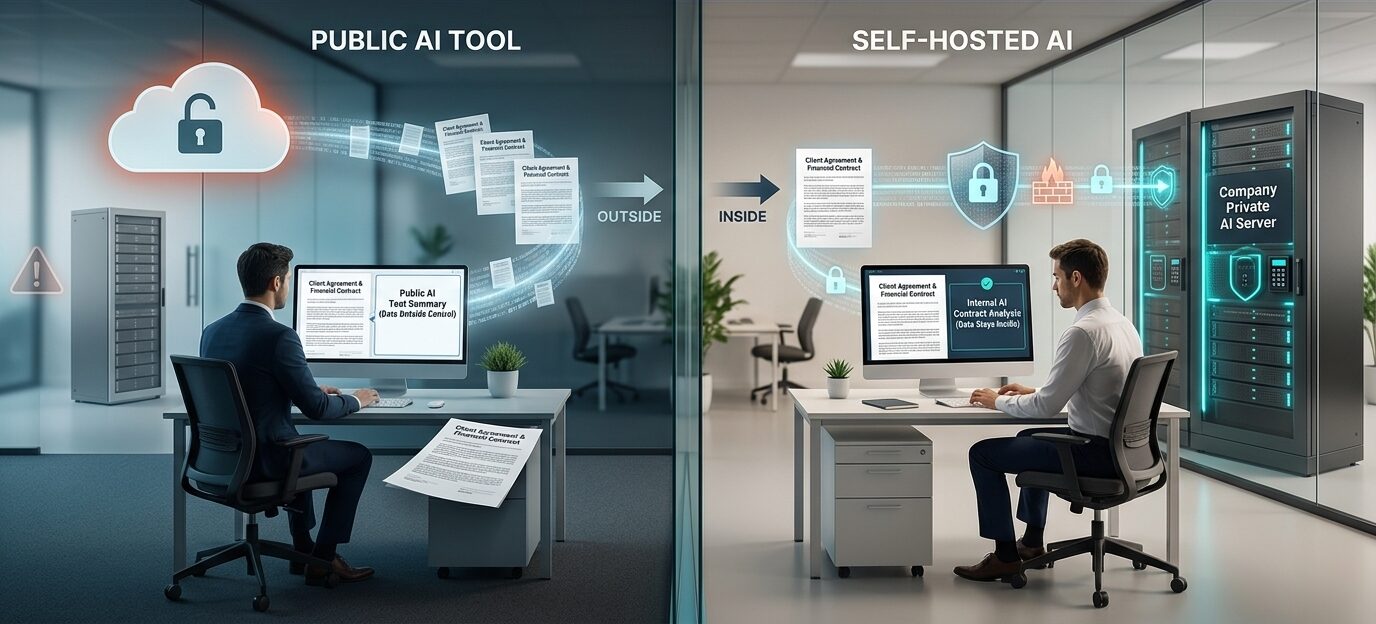
Picture this: someone on your team needs to summarize a long client agreement before a meeting in ten minutes. The fastest option is to paste it into a free AI chatbot. It works, and the summary looks great. But where did that contract just go? This is one reason businesses are turning to self hosted AI, which gives them greater control over sensitive data and how AI tools are used.
That question is at the heart of the self-hosted AI vs public AI debate, and it’s one every business should think through before AI use spreads across the whole team.
Where Does Your Information Go When You Use Public AI Platforms?
When you type something into a public AI tool, that text travels to the provider’s servers to be processed. Depending on the tool and your account settings, the provider may store or review it and even use it to train future versions of the model. Once you hit enter, you’ve lost a lot of control over where that information goes.
How Is Your Data Handled with Self-Hosted AI Systems?
With self-hosted AI (also called a private AI server), the model runs on hardware your company owns or controls.The model can run within your company’s controlled environment, giving you greater control over how data is handled. You decide how long data is kept, who can access it, and what happens to it after. If you want the full picture of how this setup works, we cover it in our guide to private AI servers.
Public AI vs. private AI: a side-by-side look
| Factor | Public AI tools | Self-hosted / private AI |
| Data privacy | Data leaves your network | Data stays on your systems |
| Cost model | Per-seat subscription, scales with headcount | Upfront setup, predictable from there |
| Customization | Limited to provider’s settings | Configured around your workflows |
| Uptime & control | Depends on the provider | Managed by your team or provider, on your terms |
| Compliance readiness | Requires extra agreements, often incomplete | Easier to align with rules like HIPAA and GDPR |
| Setup effort | None, sign up and go | Requires initial setup and onboarding |
When public AI tools are actually fine
To be fair, public AI isn’t the enemy. For brainstorming blog topics, drafting a generic social post, or researching something that has nothing to do with your business’s private information, a public tool is quick and perfectly reasonable.
When you need something more private
The moment your team is working with client details, medical information, financial records, contracts, or anything you wouldn’t want sitting on a stranger’s server, it’s time for a private setup instead. This is especially true for regulated industries — we go deeper into exactly why in how private AI servers support compliance.
What about the cost?
This is where a lot of business owners hesitate. Self-hosted AI does mean an upfront investment, while public tools charge a smaller amount per person, per month. But those monthly fees add up fast once you multiply them across an entire team, year after year. For many companies, once AI becomes something employees use every day, a private AI setup can cost less over time than paying for individual subscriptions indefinitely. It can also give businesses greater control over their data, reducing the risks that come with sending sensitive information to external AI platforms.

Making the call
There’s no universal right answer here. It depends on what your team is actually doing with AI day to day. But if your business handles anything sensitive at all, it’s worth at least getting a clear picture of what a private setup would look like for you.
Not sure which option fits your team? Let’s talk it
through.