
Modern Open-Source AI Strategy
Choosing the right artificial intelligence stack is pivotal for corporate growth. In particular, when contrasting Llama vs Qwen, decision-makers examine two leading open-weight solutions. This allows organizations to build custom Private AI Server architectures securely.
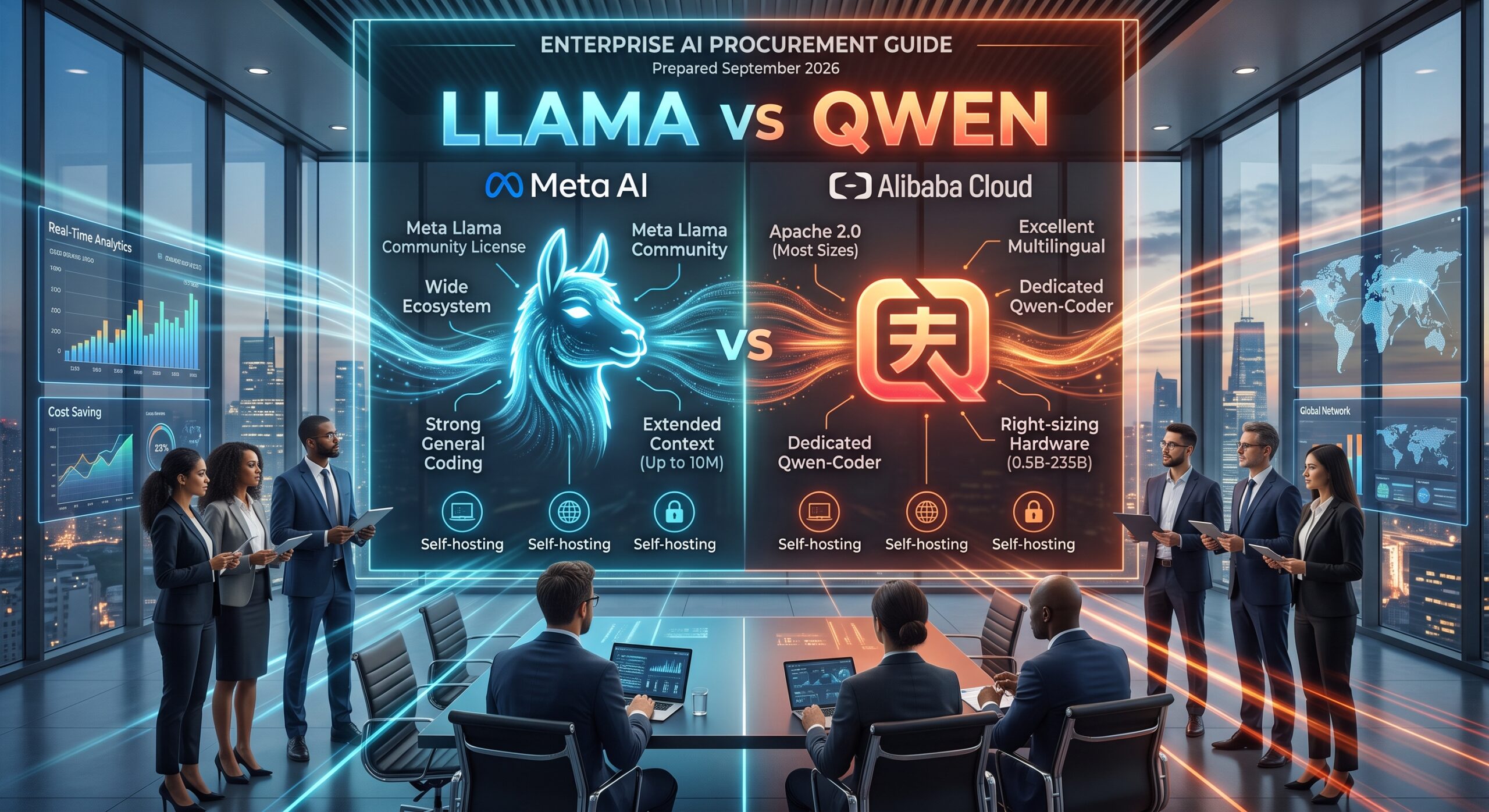
Table of Contents
- 01Executive summary: Llama vs Qwen
- 02Quick overview of Llama vs Qwen
- 03Statistical & benchmark comparison: Llama vs Qwen
- 04Which model is best for your business?
- 05Cost saving analysis
- 06Can new features be added?
- 07How much work can AI reduce?
- 08Top questions companies ask before deploying
- 09Risks and limitations
- 10Real-world business use cases
- 11Final verdict: Llama vs Qwen
- 12References
Executive summary: Llama vs Qwen
Understanding Open-Weight Foundations
To establish a solid deployment strategy, software architects must first evaluate how these open-weight ecosystems operate. Specifically, in a direct comparison of Llama vs Qwen, both represent top-tier open AI innovation. By downloading the model parameters, IT departments avoid exposing data to proprietary API layers and eliminate recurring per-token costs.
What is Meta’s Llama Framework?
Ecosystem Reach and Community Support
Developed by Meta AI, Llama stands as one of the most widely adopted open-weight model lineages. The development of an extended universe of orchestration tools, checkpoints, and hosting infrastructures has already begun around it, making it a natural choice for modern enterprise environments.
What is Alibaba’s Qwen Ecosystem?
Rapid Adoption in Coding and Multilingual Workloads
Meanwhile, Qwen represents Alibaba Cloud’s extended model family of open-weight language models. The solution achieves rapid adoption in coding, mathematics, and multilingual language modeling with frequent appearances on the Hugging Face leaderboard.
Why Are Enterprises Comparing Both Platforms?
Eliminating Vendor Lock-in and Security Concerns
Crucially, both framework families allow self-hosting and private data fine-tuning. As a result, it removes two main concerns of enterprises adopting generative AI: vendor lock-in and data privacy, allowing teams to evaluate performance reports side by side.
Quick overview of Llama vs Qwen
Comprehensive Feature Matrix
A brief description of the model families highlights the main differences. The structured table below demonstrates variations in specifications, licenses, and infrastructure requirements across 16 core dimensions.
| Feature / Dimension | Llama Ecosystem | Qwen Ecosystem |
|---|---|---|
| Developer / Creator | Meta AI (Meta Platforms, Inc.) | Alibaba Cloud (Qwen Team) |
| Primary License Type | Meta Llama Community License (“open weight”) | Apache 2.0 (most sizes); custom commercial for “Max” variants |
| Commercial Usage Terms | Free for all businesses under 700M active monthly users | Free and fully unlimited for all Apache-licensed models |
| Hosting & Deployment | Self-hosted, AWS, Azure, GCP, Ollama, vLLM | Self-hosted, Alibaba Cloud, Hugging Face, Ollama, vLLM |
| Coding Performance | Strong general-purpose code generation | Industry-leading (Qwen-Coder specialized series) |
| Mathematical Reasoning | High accuracy across GSM8K and MATH benchmarks | Exceptional performance via specialized math checkpoints |
| Multilingual Proficiency | Strong English + major European and Asian languages | Exceptional breadth across Asian, European, and regional dialects |
| Context Window Support | Massive context lengths available in latest versions | Extended context capabilities across 7B, 14B, and 72B tiers |
| Fine-Tuning Flexibility | Fully supported via LoRA, QLoRA, and full parameter tuning | Highly receptive to custom domain fine-tuning and distillation |
| Tool & Function Calling | Native structured JSON and tool execution support | Robust native tool-use and agentic planning capabilities |
| Data Security & Privacy | 100% air-gappable / self-hostable within local infrastructure | 100% air-gappable / self-hostable within local infrastructure |
| Ecosystem & Integrations | Extensive cloud marketplace presence (Bedrock, Azure AI) | Rapidly expanding global open-source community support |
| Hardware Optimization | Broad support across NVIDIA, AMD, and Apple Silicon | Highly optimized quantization paths (GPTQ, AWQ, EXL2) |
| Agentic Workflow Support | Compatible with LangGraph, CrewAI, and AutoGen | Built-in reasoning modes optimized for multi-step planning |
| Compliance & Auditing | Well-documented enterprise compliance deployment guides | Transparent weight releases and reproducible benchmarks |
| Overall Value Proposition | Best-in-class tier-one brand trust and cloud integration | Exceptional cost-to-performance ratio and licensing freedom |
Statistical & benchmark comparison: Llama vs Qwen
Which model is best for your business?
Organizations should consider their scale, operational mandates, and internal competencies to determine the best fit between Llama and Qwen deployment options across different business segments.
| Business Segment / Use Case | Recommended Model | Why It Fits |
|---|---|---|
| Startup | Qwen | Apache 2.0 removes legal review overhead; small sizes keep infra costs near zero while validating product-market fit. |
| Small business | Qwen | Runs on modest hardware; no user-count licensing restrictions as you grow. |
| Medium business | Either | Long-context document work favors Llama; coding/multilingual work favors Qwen. |
| Enterprise | Llama | Deeper ecosystem (Bedrock, Azure AI Foundry); confirm licensing early if near the 700M MAU threshold. |
| Government | Either (self-hosted) | Both can be fully air-gapped; choice often follows existing procurement relationships. |
| Healthcare | Llama | Larger ecosystem of compliance-adjacent deployment guides on Azure/AWS. |
| Financial services | Qwen | Stronger math/reasoning benchmarks for risk modeling and reconciliation. |
| E-commerce | Qwen | Multilingual strength supports listings and chat across international markets. |
| SaaS company | Qwen | Qwen-Coder variants are purpose-built for embedded coding copilots. |
| Call center | Qwen | Cheaper multilingual small models suit 24/7 multi-language coverage. |
| Education | Llama | Broadest base of existing educational tooling and fine-tuned tutors. |
Practical example: A mid-sized logistics company running multilingual support across Southeast Asia found a fine-tuned Qwen 7B handled 70% of routine shipment-status queries across five languages, while an equivalent Llama deployment needed an extra translation layer to match the same coverage.
Cost saving analysis
Deploying open-weight models provides significant productivity advantages by automating repetitive tasks and reducing administrative overhead across departments.
| Function / Task | Manual Baseline | AI-Assisted Workflow | Reclaimed Time |
|---|---|---|---|
| Customer support | Agents answer every ticket manually | AI drafts/resolves routine tickets; agent reviews exceptions | 10–15 hrs/wk per agent |
| Email handling | Manual triage and drafting | AI drafts replies, sorts priority | 5–8 hrs/wk per employee |
| Content writing | Writer drafts from scratch | AI produces first drafts, human edits | 6–10 hrs/wk per writer |
| Lead qualification | Rep manually screens every lead | AI scores/pre-qualifies from forms and chat | 4–6 hrs/wk per rep |
| Reporting | Manual data pulling and summarizing | AI auto-generates weekly/monthly summaries | 3–5 hrs/wk per manager |
| Data analysis | Analyst manually queries and interprets | AI assists with query generation and first-pass insights | 5–7 hrs/wk per analyst |
| Software development | Developers write all boilerplate manually | AI handles boilerplate, tests, docs | 6–12 hrs/wk per developer |
| Documentation | Manual writing and upkeep | AI drafts and updates docs from source material | 4–6 hrs/wk per team |
| Internal knowledge search | Employees ask colleagues or dig through wikis | AI answers instantly from the knowledge base | 2–4 hrs/wk per employee |
Illustrative math: a 50-person company where each employee reclaims a conservative 4 hrs/week at a fully loaded cost of $40/hr recovers roughly $416,000/year in reclaimed time. Actual results depend on integration quality, fine-tuning depth, and adoption — treat this as a planning estimate, not a guarantee.
Can new features be added?
Can Llama be customized?
Yes. Meta releases full model weights, so your team (or a vendor) can fine-tune it on your tone, terminology, and internal data using LoRA or full fine-tuning.
Can Qwen be customized?
Yes, with the same techniques. Because most Qwen sizes are Apache 2.0, you get more legal freedom in how customized versions are redistributed or embedded in your own products.
Can developers add new features?
Yes for both — features are built as an application layer around the model: retrieval-augmented generation (RAG) for knowledge access, tool-calling for actions, and orchestration frameworks to chain steps together.
Can developers connect CRMs, WhatsApp, websites, or ERPs?
Yes to all four. Both models support function/tool calling, so a developer wires the model to call your CRM, ERP, or messaging API (Salesforce, HubSpot, SAP, WhatsApp Business API) to pull data or trigger actions as part of a conversation. Website chat widgets follow the same backend-API pattern.
Can developers build AI agents?
Yes. Both support agentic workflows — multi-step planning, tool use, memory — through frameworks like LangGraph or CrewAI. Qwen’s built-in reasoning mode is particularly well-suited to multi-step agent planning.
Can developers train on company documents?
Yes, two ways: RAG retrieves relevant document chunks at query time without retraining (faster, cheaper to maintain), or fine-tuning bakes knowledge into the weights (requires retraining when documents change). Most businesses should start with RAG.
Can developers create industry-specific assistants?
Yes — this is one of the most common enterprise patterns: legal, healthcare, insurance, and financial firms fine-tune or RAG-augment these models with domain documents, terminology, and compliance guardrails.
How much work can AI reduce?
Customer service teams can fully resolve routine, repetitive queries and draft first responses for complex ones. Sales teams get AI-qualified leads and drafted outreach. Marketing gets first-pass copy across formats. HR gets resume screening and policy Q&A. Operations gets automated report summaries and anomaly flags. Finance gets reconciliation assistance and first-draft summaries — with human review remaining essential for anything filed externally. Development teams offload boilerplate code, tests, and documentation.
| Department | Manual Work Reduction |
|---|---|
| Customer service | 40–60% |
| Sales | 20–35% |
| Marketing | 30–50% |
| HR | 25–40% |
| Operations | 20–35% |
| IT | 30–45% |
| Finance | 15–30% |
Assumptions: these ranges assume real integration (not a bolted-on chatbot), continued human review for customer-facing or compliance-sensitive output, and at least basic fine-tuning or RAG setup. Actual reduction varies with process maturity and data quality.
Top questions companies ask before deploying
Which model is cheaper?
Depends on the model size chosen, not the brand — a small Qwen model is cheaper to run than a large Llama model, and vice versa. Compare total infrastructure plus engineering cost for your specific workload.
Which model is easier to deploy?
Both have mature tooling (Ollama, vLLM, Hugging Face Transformers). Qwen’s smaller sizes are easier to start with on limited GPU budgets.
Which model is more secure?
Neither is inherently more secure — security depends on deployment. Self-hosting either model keeps data fully in your control.
Which model supports private servers?
Both can be fully self-hosted on-premises or in a private cloud, with no data sent to the model developer.
Can it run offline?
Yes, both can run fully air-gapped once weights are downloaded, given sufficient local hardware.
Can it integrate with existing software?
Yes, through APIs and function/tool calling — standard for both.
What hardware is required?
A single consumer/prosumer GPU (16–24GB VRAM) for small models up to ~8B parameters; multi-GPU enterprise servers for the largest models (70B+).
How much training data is needed?
None for RAG — you use existing documents as-is. For fine-tuning, useful results are often achievable with a few hundred to a few thousand high-quality examples.
How long does implementation take?
A basic RAG chatbot pilot: 2–6 weeks. A production-grade, fine-tuned, fully integrated deployment: 2–6 months depending on complexity.
What ROI can companies expect?
Varies widely; most see measurable time savings within the first quarter, with fuller ROI typically realized over 6–18 months as integration and adoption mature.
Does it replace employees?
In most deployments, no — it reduces time spent on repetitive tasks and shifts human effort toward judgment-heavy and relationship-heavy work.
Can it generate inaccurate answers?
Yes — called “hallucination,” and it applies to all large language models, not just Llama or Qwen. See risks and mitigations in Section 9.
How do we secure company data?
Self-host on infrastructure you control, encrypt data at rest and in transit, apply role-based access control, and avoid sending sensitive data to third-party APIs without a proper data processing agreement.
What industries benefit most?
Customer-service-heavy industries (e-commerce, telecom, banking), document-heavy industries (legal, insurance, healthcare), and software companies see the fastest returns.
Do we need a data science team?
Not necessarily for RAG-based deployments; fine-tuning and production-scale deployment benefit from experienced ML/engineering support.
Can small businesses afford this?
Yes — small open models (0.5B–8B parameters) run on modest hardware or affordable cloud instances.
Is fine-tuning mandatory?
No. Many businesses get strong results from RAG alone before ever fine-tuning.
How do we measure success?
Track ticket resolution time, first-response time, employee hours reclaimed, and customer satisfaction before and after deployment.
What if the model is wrong in a customer-facing scenario?
Build a human-in-the-loop review step for anything with legal, financial, or safety implications.
Can we switch models later?
Yes — a key advantage of open-weight models is that your application layer (RAG, tools, integrations) can generally point at a different underlying model with moderate re-engineering.
Do we need internet access to use these models?
No, once weights are hosted internally — though hosted API options exist if you’d rather not manage infrastructure.
Are there compliance certifications for these models?
The models themselves aren’t “certified”; compliance depends on your deployment environment — check your cloud provider’s SOC 2, HIPAA, or ISO 27001 documentation for the hosting layer.
What’s the biggest hidden cost?
Ongoing maintenance, monitoring, and data-pipeline upkeep — not the model license itself.
Can this handle multiple languages in one deployment?
Yes, especially with Qwen, which was designed with strong multilingual coverage from the start.
Who owns the output generated by these models?
Generally your organization retains rights to output from self-hosted open-weight models, but confirm specifics in the applicable license — and have legal review Llama’s community license terms specifically.
Risks and limitations
Hallucinations
Both models can generate plausible-sounding but incorrect information. Mitigation: ground answers in verified documents via RAG, require citations, keep humans in the loop for high-stakes output.
Data privacy
Sending sensitive data to third-party hosted APIs creates exposure. Mitigation: self-host on infrastructure you control, use data processing agreements with any third-party host.
Security risks
Prompt injection and data leakage through poorly designed integrations. Mitigation: sanitize inputs, restrict tool-calling actions, apply least-privilege access to connected systems.
Compliance
Regulated industries face specific data-handling requirements. Mitigation: map your deployment against relevant frameworks (HIPAA, GDPR, SOC 2) before go-live, and involve legal early — especially for Llama’s scale-based licensing terms.
Infrastructure costs
Larger models require meaningful GPU investment. Mitigation: right-size the model; many business use cases work fine on 7B–14B models rather than the largest flagship versions.
Maintenance requirements
Models and surrounding tooling need ongoing updates. Mitigation: budget for a dedicated internal owner or managed-service partner.
Model bias
Training data can encode unintended biases. Mitigation: test outputs across diverse scenarios before launch and maintain a feedback channel for reporting issues.
Real-world business use cases
Clinical documentation drafting and internal guideline Q&A, with clinician review of all output.
Fraud pattern summarization, customer query triage, internal policy assistants.
Claims document summarization and first-pass underwriting notes.
Equipment manual Q&A and maintenance log summarization.
Multilingual product descriptions and customer chat support.
Shipment status chatbots and multilingual notifications.
Personalized tutoring assistants and first-pass grading feedback, with instructor review.
Property description generation and lead-qualification chat.
In-product AI copilots for coding, support, and onboarding docs.
Self-hosted citizen-service chatbots for FAQs, with data sovereignty maintained on government infrastructure.
Final verdict: Llama vs Qwen
When concluding your AI deployment strategy, building a secure Private AI infrastructure ensures long-term scalable growth.
Permissive licensing and low-cost small models remove friction while finding product-market fit.
Runs affordably and scales with you.
Llama for long-context document work, Qwen for coding or multilingual-heavy needs.
Deeper cloud partnerships and ecosystem maturity — clear the licensing review at scale.
Multilingual support is a core design strength, not an add-on.
The dedicated Qwen-Coder line consistently benchmarks near the top of open coding models.
Broader range of small, efficient sizes lowers the infrastructure floor.
Best default for most mainstream business applications — Llama remains stronger specifically for maximum context length or deep AWS/Azure integration.
Bottom line: there’s no universal winner — there’s a better fit for your workload. Run a small proof-of-concept with both models on your actual data before committing budget.
References
- Meta AI, “The Llama 3 Herd of Models”, arXiv, 2024.
- Qwen Team, “Qwen2.5-Coder Technical Report”, arXiv, 2024.
- Qwen Team, “Qwen2.5-Math Technical Report: Toward Mathematical Expert Model via Self-Improvement”, arXiv, 2024.
Model versions, licensing terms, and benchmark scores for both families change frequently. Before finalizing a procurement decision, verify current terms on Meta’s official Llama site and Alibaba’s official Qwen documentation or Hugging Face model cards, and validate benchmark claims against your own evaluation on representative business data.