

A few weeks ago, an employee at a mid-size company copied a client contract into a free AI chatbot to get a quick summary. It seemed harmless. Yet after the employee submitted the contract, an outside company stored it on a server beyond the business’s control. This exact situation repeats itself daily in workplaces across the globe. It is one of the hidden risks in business today and it is why more companies are asking about private ai servers.
What is a private AI server?
Think of it this way: a public AI tool, like the free version of ChatGPT, runs on someone else’s computers. Every question you type travels to their servers, gets processed there, and may even be stored or used to improve their product.
A private AI server turns that around. It is your AI system, running on hardware in your office or in a private cloud environment that your company controls. Your team can still ask questions draft emails summarize documents and automate busywork. None of that data ever leaves your company. You can read more about how this setup works on Mobit Solutions’ AI server page.
How is it different from ChatGPT or other public tools?
These tools use a language model, also known as an LLM, as their AI “brain.” In contrast, public tools run their LLM on shared servers that serve millions of people. A private AI server runs the technology on a system that your company controls and only authorized employees can access. No other data mixes with yours. No outside party can see what your team asks.
Why are businesses switching to AI?
- Your data stays yours. Contracts, customer records, and financial details never get sent to an outside company.
- You set the rules. You decide who can use it, what it can access, and how long records are kept.
- Fewer compliance headaches. This matters a lot for industries like healthcare and finance — we cover this in detail in our compliance guide.
- Costs stay predictable. There are no surprise bills as more employees start using AI daily.
- The private AI server grows with your business. Start with one team and expand access across the company once the system proves its value.
Who actually needs an AI server?
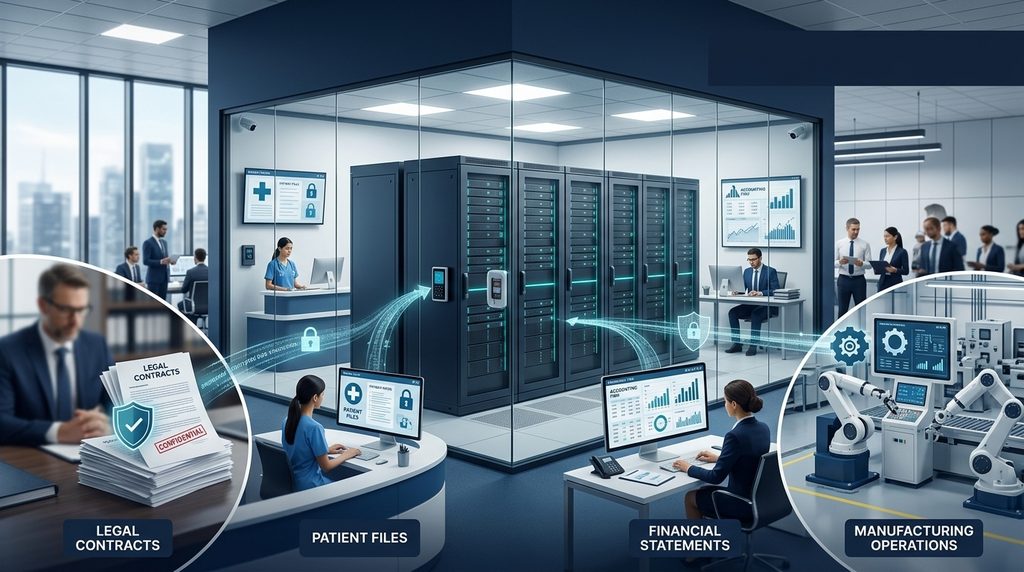
This isn’t something that only large tech firms can do. Any business that handles sensitive information, such as customer records, contracts, medical files, financial statements, or internal strategy documents, can benefit from keeping that data in-house. This covers a huge range of companies, including clinics, law firms, accounting practices, manufacturers, and many regular mid-size businesses that simply do not want their data leaving the building.
Common myths cleared up
It is for huge companies with big IT budgets. That is not true anymore. Private AI infrastructure setups scale down to fit small and medium businesses too, and they can start small and grow.
It is a nightmare to maintain. With the right provider, a private AI server comes with ongoing monitoring and support, so your team is not stuck troubleshooting servers on their own.
If you are weighing an AI server against just using ChatGPT for work our next article breaks down self-hosted AI versus public AI tools side, by side.
Getting started
For most organizations, the journey begins with a straightforward discussion: what sensitive information needs protection, how is your workforce currently leveraging AI, and what would a more secure configuration actually resemble? From there, it’s a matter of installing the system, connecting it to your existing tools, and training your staff to use it well — a process we walk through step by step in our setup guide.
Curious whether a private AI server makes sense
for your business?